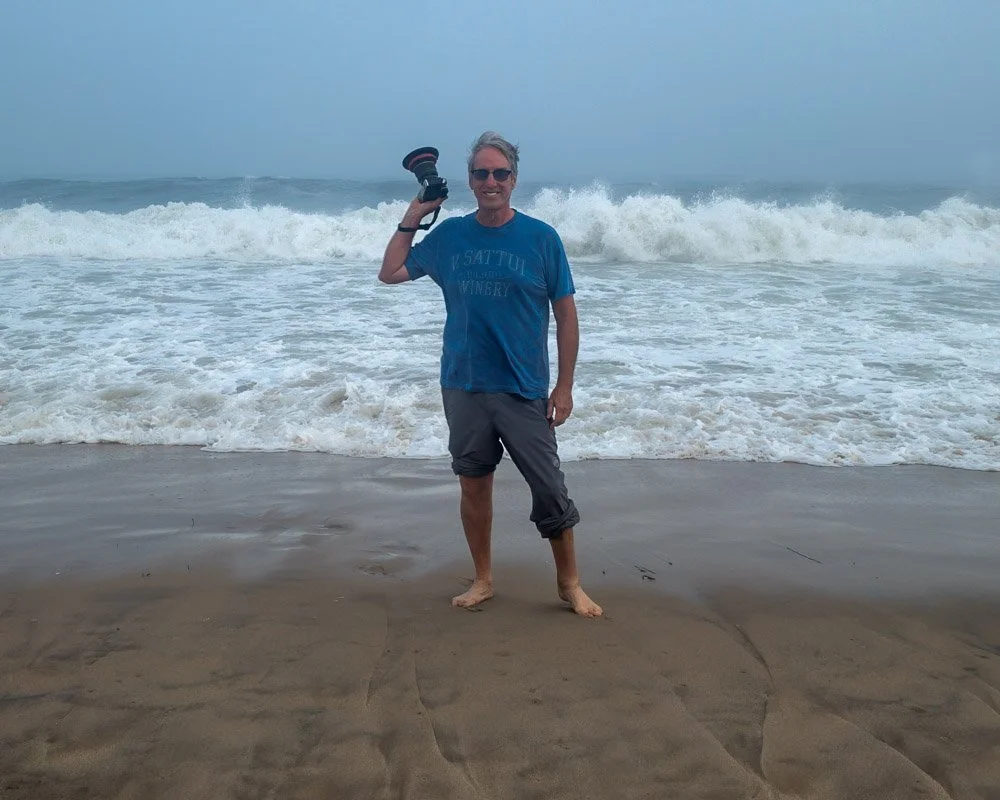
Growing up in the 1950s, I remember families bringing out their Kodak Brownie cameras for special occasions. My family felt different—cameras were everywhere, picked up for any number of reasons. Photographs were not simply records of events, but an essential dimension of living. My mother’s well-used Polaroid captured the fun of family life and neighborhood antics. My father’s photography was embedded in his work assessing the damage and costs of disasters—earthquakes, fires, and mining accidents. He traveled constantly, often arriving at the airport just as news of a catastrophe reached the evening broadcast. Beyond photographs supplementing his reports, he tried to capture what it felt like to be there: filming volcanoes from helicopters or discreetly using a miniature “spy” camera to catch fleeting moments during a political coup. Life was meant to be lived, but also captured on film. This duality—everyday family moments alongside exotic, sometimes dangerous locations—shaped how I came to see and imagine the world.
I began photographing in earnest during college in the late 1960s, a period marked by sweeping social change and political activism. Attending a small college in rural Maryland, about an hour from Washington, D.C., gave me opportunities that extended well beyond campus life. I wandered the back roads of Appalachia, photographing quiet hollows and worn front porches edged with discarded furniture and appliances. On weekends, I traveled to Washington, where student demonstrations and antiwar protests filled the streets with marches, speeches, and, at times, the sharp sting of tear gas. Moving between these very different worlds—rural isolation and collective unrest—shaped both how I photographed and how I thought. During this time, I shifted my major from pre-law to psychology, a field also undergoing profound change, with growing attention to inner life, unconscious experience, and consciousness-raising.
My training eventually led to postdoctoral studies at NYU, followed by years in private practice, teaching, and raising a family. Over time, photography and psychology began to converge. What once felt like separate pursuits gradually revealed a shared way of seeing—one that moved away from fixed roles of observer and subject toward something more relational and alive. In both, I learned the value of slowing down, paying attention, and allowing meaning to emerge rather than forcing conclusions. This sensibility continues to inform my work, whether in the consulting room or behind the camera, where remaining present long enough allows something layered and resonant to take shape.